Configuration
The configuration of the dynamic checklist refers to installation and configuration of the addon.
For instructions on how to build your checklist, go to How it works.
Configuration consists of these points:
- Lime Admin
- Template builder
- Checklist
Lime Admin
General config
In Lime Admin you do general configuration of the addon. You will find the settings in Lime Admin > Settings > Dynamic Checklist
Configure Checklist Owner(s)
Here you declare which Limetypes are Checklist Owner(s) followed by Template Property. This will affect what limetypes that are available in the Template builder.
Owner Limetyperefers to the limetype where the checklist should be visible E.ghelpdesk.Template Propertyis a related limetype to the Checklist Owner, e.g.helpdesktype. Each template property has one connected checklist template.
Example for helpdesk:

Danger
Want to add new checklist owner after installing? All Checklist Owners needs the initialize checklist automation and the required data structure.
Run the addon installer for the given checklist owner and make sure to add the Initialize checklist automation For more information see Automation section under installation.
History types
Automatic history
When checking/unchecking checklist items automatic history notes are created.
Per default the checklist history type is used, but this can also be configured to use any other type.
Forced history
When using the Force history note on a checklist item
Per default the comment history type is used, but this can also be configured to use any other type.
Security (Access)
In Lime Admin you do security configuration of the addon. You will find the settings in Lime Admin > Settings > Dynamic Checklist > Security
Who can edit checklists (Groups allowed to edit in the Checklist Template Builder)
Configure which LISA-groups that should be able to open the Checklist Template Builder and create or edit checklist templates.
Administrators doesn't not automatically have access, so don't forget to add them!
Info
This is checked both in the browser and on the server. If a user is not in one of these groups, they won't be able to save a checklist, even if they somehow reach the builder.
Who can view checklists (read-only)
Configure which groups should be able to open the Checklist Template Builder to view checklist templates without being able to change anything.
- If you add one or more groups, only those groups (together with the edit groups above) can open the builder in read-only mode.
- If you leave it empty, everyone can view checklists in read-only mode.
This is useful when you want coworkers to be able to see how a process is set up, without giving them the ability to change it.
Template builder
Browser Menu Item
Add the checklist builder to the browser menu with this configuration:
{
    "path": "checklist-builder/",
    "title": "Checklist builder",
    "icon": "checklist",
    "color": "rgb(var(--color-cyan-default))"
}
Info
Note that the Browser Menu Item will be visible to all users. A user without access that navigates to the builder will be shown an 'Access denied' message.
Checklist web component
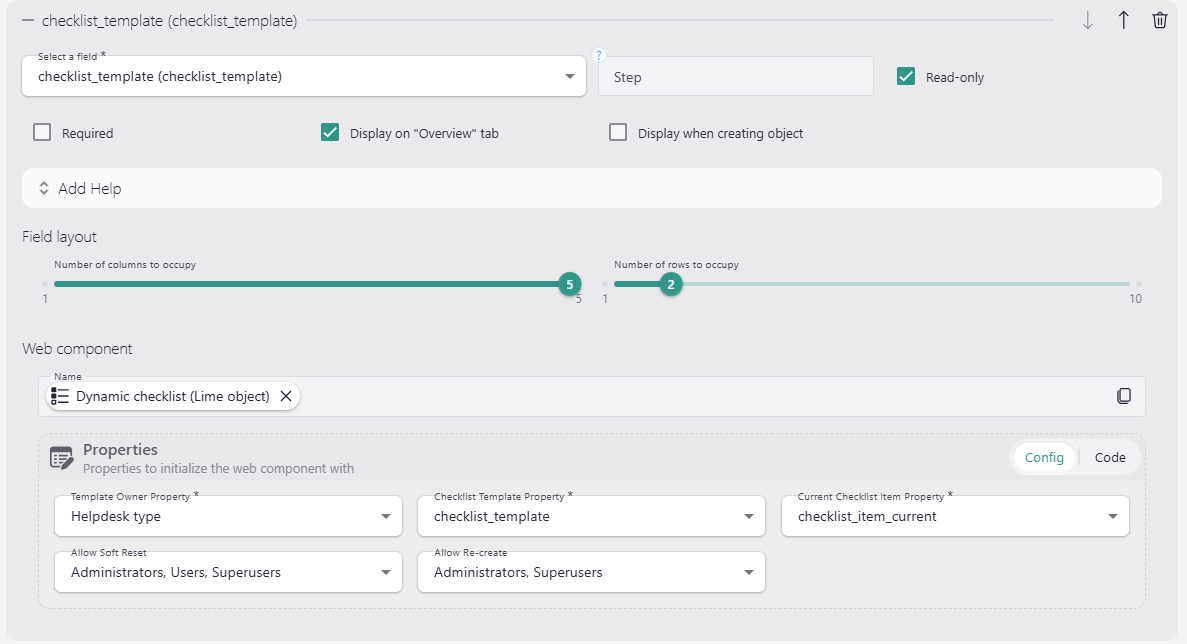
The checklist web component can be put in either a custom tab, or as a card property.
Card Property
- Add the checklist webcomponent
lwc-limepkg-dynamic-checklist-limeobjectto the read-only fieldchecklist_template. - Set the
colSpanto 5 androwSpanto 2. - Configure the
Template Owner Property,Checklist Template PropertyandCurrent Checklist Item Property - [Optional] enable
Soft ResetandRe-createfor permitted groups.
Example
{
    "property": "checklist_template",
    "readonly": true,
    "visible": true,
    "visibleOnCreate": false,
    "notifyCoworker": true,
    "help": {
        "readMoreLink": {
            "target": "_blank"
        }
    },
    "layout": {
        "colSpan": 5,
        "rowSpan": 2
    },
    "component": {
        "name": "lwc-limepkg-dynamic-checklist-limeobject",
        "props": {
            "templateOwnerProperty": "helpdesktype",
            "checklistTemplateProperty": "checklist_template",
            "currentChecklistItemProperty": "checklist_item_current",
            "security": {
                "allowRefreshTemplate": [
                    "Administrators",
                    "Users",
                    "Superusers"
                ],
                "allowReCreate": ["Administrators", "Superusers"]
            }
        }
    }
}
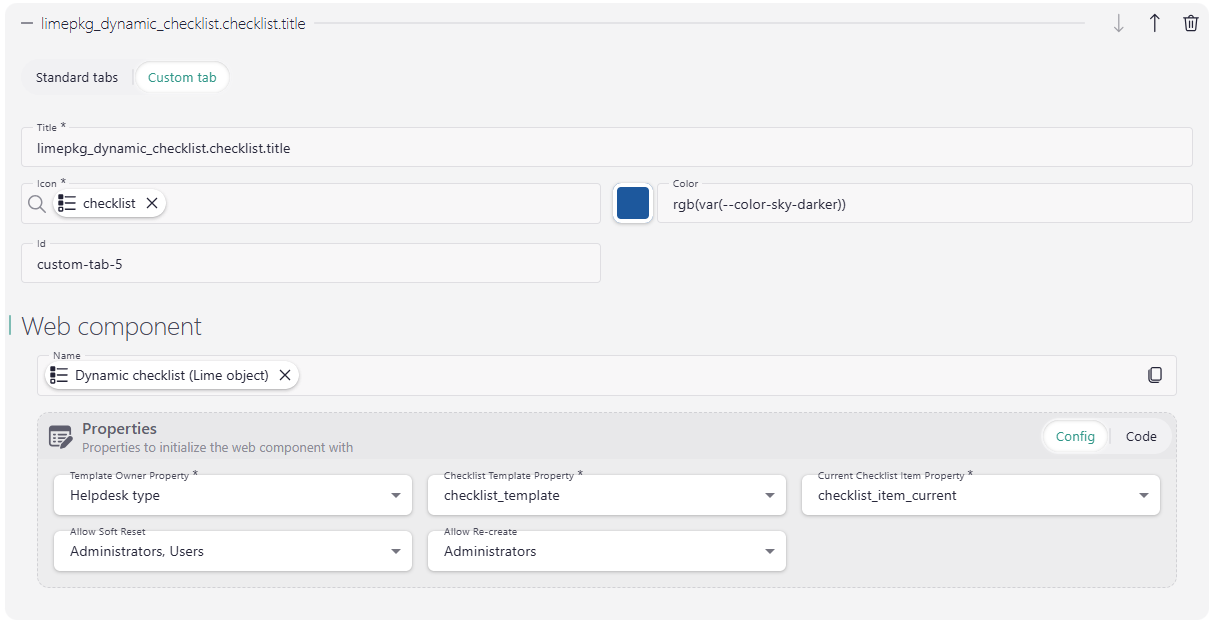
Custom tab
- Create a new custom tab where the checklist should be shown.
- title:
limepkg_dynamic_checklist.checklist.title - icon:
checklist
- title:
- Add the checklist webcomponent
lwc-limepkg-dynamic-checklist-limeobject. - Configure the
Template Owner Property,Checklist Template PropertyandCurrent Checklist Item Property - [Optional] enable
Soft ResetandRe-createfor permitted groups.
Example
{
    "title": "limepkg_dynamic_checklist.checklist.title",
    "icon": "checklist",
    "color": "rgb(var(--color-sky-darker))",
    "id": "custom-tab-5",
    "component": {
        "name": "lwc-limepkg-dynamic-checklist-limeobject",
        "props": {
            "templateOwnerProperty": "helpdesktype",
            "checklistTemplateProperty": "checklist_template",
            "currentChecklistItemProperty": "checklist_item_current",
            "security": {
                "allowRefreshTemplate": ["Administrators", "Users"],
                "allowReCreate": ["Administrators"]
            }
        }
    }
}
Template owner card
You can add a small component to the card of a checklist template owner (for example a helpdesktype or dealtype record) that shows which checklist template is connected to that record.
It tells the user whether a checklist template already exists for that record, and lets them jump straight into the Checklist Builder to open the existing template or create a new one.
- If the user is allowed to edit checklists, they get a button to open or create the template.
- If they are not allowed to edit, they only see whether a template exists.
- It also shows a warning icon if the connected template has validation problems.
To use it, add the component lwc-limepkg-dynamic-checklist-template-owner to the card of your template owner limetype (for example on the helpdesktype card).
Example
{
    "component": {
        "name": "lwc-limepkg-dynamic-checklist-template-owner"
    }
}
See From a record (template owner card) for screenshots of the component with and without a connected template.
Info
The component uses the checklist owner configuration you set up under Configure Checklist Owner(s) to figure out which records are template owners. Make sure that is configured first.